
When your own community treats your assault like gossip

From my assault to the murders of Black women across the country – trivialization is the weapon, and solidarity is the only answer (Shutterstock Creative/Bits and Splits)
I was bleeding on the floor, shocked and confused about what had occurred.
Minutes earlier, I was violently attacked by someone who, while not a friend, was not an enemy. Whenever I saw them, I would at least say hello and keep going. In fact, I had done it only two or three days prior at the same establishment. But there I was, my face bruised, hair tousled, and nail ripped off. And I had just gotten them done earlier, too.
I was in shock when the police and EMS arrived. Calm and soft-spoken, replaying what had occurred leading up to the event: the assailant coming into the bar yelling, and my friend and I were shocked in disbelief. In the days that followed, I was sad. Depressed, even. Moving from the bed to the couch, watching Bob's Burgers and The Crown as I wafted in and out of sleep. I was even eating foods I absolutely should not have been eating after getting jaw surgery as part of my FFS: burritos and beef patties — moments of reflection; moments of sobbing.
My friends and family checked in from time to time to see if I was okay. One of my friends told me other people in the community were trying to check in on me, too: not for my sake, but to find out and gossip about it. One person allegedly told a friend the need for "teatime" was overdue.
I was shocked, once again. These were people in their 40s and 50s. Why behave like a 20-year-old? This wasn't a trivial matter, but I had to quickly remind myself of what it feels like to be a Black trans woman asking the world to care.
When asking the world to care, the world has made it very clear, repeatedly and without apology, that it has other priorities. Trivializing the horrific experiences of Black women – cis or trans – and turning them into a form of gossip or hot takes isn't new, either.
Two weeks ago, Dr. Cerina Fairfax was killed by her estranged husband, former Virginia Lt. Governor Justin Fairfax, in their Annandale home. Court documents show that police had already investigated a false assault claim he made against her. The judge apparently noted the tension, and the warning signs were already in the record. She had done everything right: filed for divorce, went to court, and asked the system to protect her. PBS noted the court ordered him out of the home, but still granted him unsupervised visitation. Three days later, she was dead. Her children were in the house.
Then, on April 19th, a man in Shreveport, Louisiana, killed eight children, seven of them his own. Many of them were shot in their sleep, according to Time. He shot his wife, Shaneiqua, and his ex-wife, Christina. He did it the morning they were due in court, reportedly making threats years earlier that if they tried to leave, he would kill them, the kids, and himself. Someone believed him enough to remember it. Nobody believed him enough to stop it.
One week, and two Black women who tried to leave. One of whom paid for it with her life, and one who survived to carry what was taken from her.
And yet, we've seen what happened in the conversation that followed. How quickly the pivot was toward a man's mental health, his stress, his pain. There is intense speculation about how these elements played in both cases. As if Cerina Fairfax didn't have stress. As if Shaneiqua Pugh didn't have fear. As if their survival, grief, and impossible position merit less column space than his unraveling.
This is what trivialization looks like. Not always a slur. Not always a dismissal. Sometimes it's a reframe: make the perpetrator the subject of inquiry, and the woman becomes a footnote in his story.
Dr. Tameka Gillum, a public health researcher who has identified Black women's murder rate as a national crisis, put it plainly. "We worry for the welfare of ourselves, our daughters, our mothers, sisters, partners, friends, and other loved ones," she stated. The historic and contemporary devaluation of Black women's worth, the lack of trust with police, and the lack of media coverage further perpetuate the systemic abuse. A similar study from Columbia University also found that Black women's femicide rate has remained more than four times higher than white women's across two full decades. That is not a statistic. That is a policy. That is a choice: made in every newsroom that doesn't assign or minimizes the story, every courtroom that grants unsupervised visitation, and every community that treats a woman's attack or death as teatime.
And I know, more intimately than I wish I did, what it looks like when it arrives not as a headline but as a whisper in your own community.
I want to be clear about something: what happened to Dr. Cerina Fairfax, Shaneiqua Pugh, and many others is femicide. The system failed them, the warning signs were ignored, and the discourse bent itself into knots to center the men who killed. That is a pattern I recognize in my bones, because it is the same pattern that governs what happens when a Black trans woman is hurt.
Except for us, there is an additional line item. Call it the trans tax.
When a Black trans woman is assaulted – bleeding on the ground in a parking lot, calm and soft-spoken with the police because she has learned that anything else is dangerous – the response is rarely uncomplicated grief. There is almost always a qualifier. A caveat. A question that functions as a verdict. Well, where was she? What was she doing there? Did she disclose? As if our presence in the world requires a disclaimer. As if surviving requires a justification.
The violence we face is not incidental. It is structural and staggering. Black trans women are among the most targeted people in this country, yet the least covered when something happens to us. Our deaths, when reported at all, are sometimes misgendered or print the wrong name. Our murders get filed under the wrong category, or our attacks are overlooked and underinvestigated by authorities. Placed in the wrong database, or no database at all, because the same systems that fail to track Black women's deaths have built entire blind spots around us.
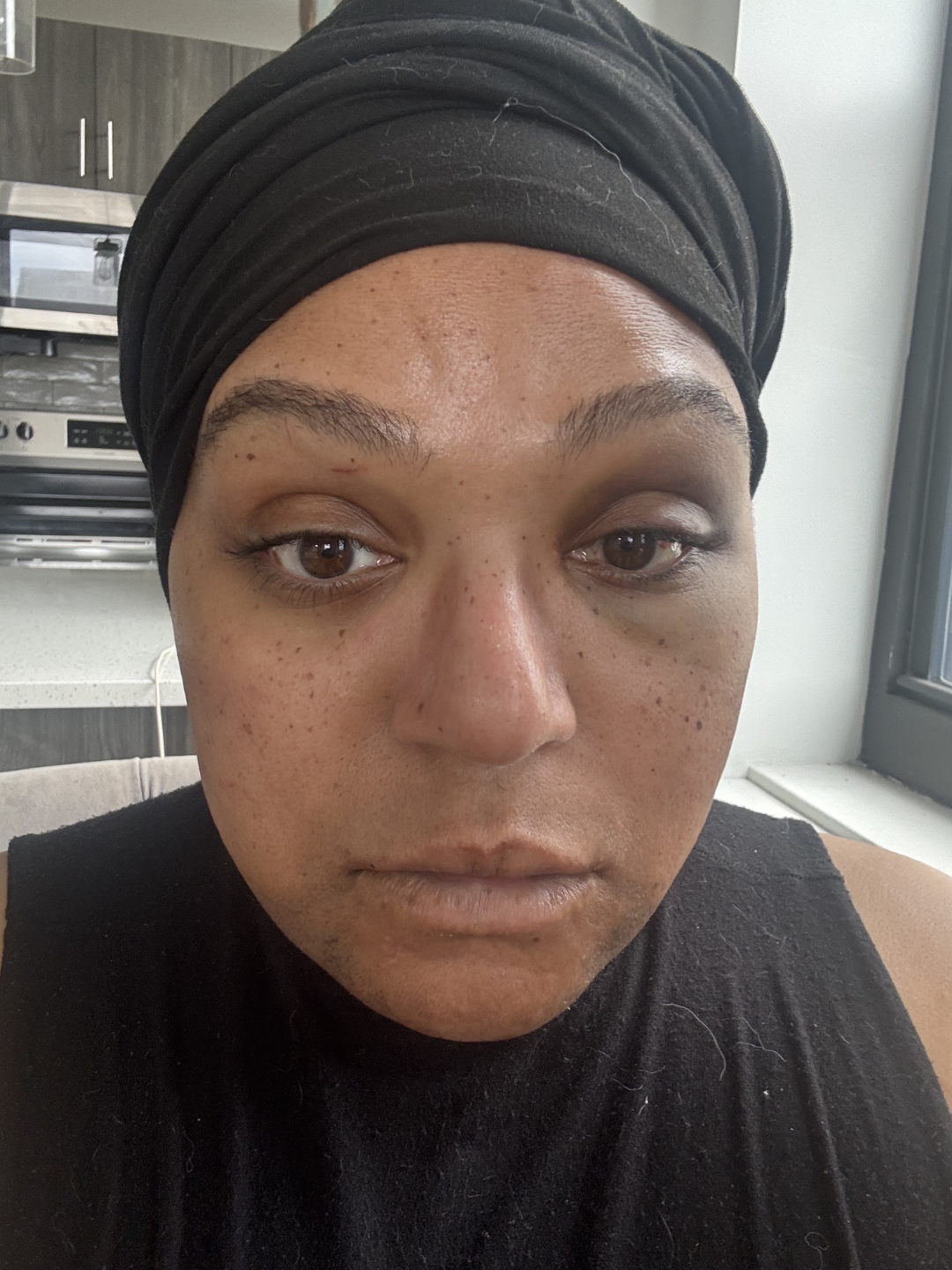
Bruised, not broken: A photo I took days after the assault.
And when we survive, the trivialization takes a different shape. It looks like gossip. It looks like a community of grown adults treating another person's assault like a plot point. It looks like someone decided my pain was information they were owed rather than a wound that deserved space.
Here is what rarely gets said plainly: the trans-specific layer of this trivialization is not separate from the misogyny that killed Cerina and endangered Shaneiqua. It is downstream of the same current. Of the same current that has decided certain women are asking for it by simply being alive and refusing to be governed by an oppressive system.
The difference is that when cis Black women are brutalized, there is at least a moment of public reckoning. A hashtag. A CNN segment. A politician's statement. For Black trans women, we often don't get that. We get a brief. Possibly a headline, if we get one at all. But certainly, community members and commentators are mining our trauma for teatime.
The system doesn't just fail us. It was built assuming we don't matter, and maintained, quietly, by people who should know better.
There is a rift. It has existed for quite some time, built on perceived threats of what womanhood looks like. Curated content that challenges shared definitions, pronouns, looks, dating pools, and so on. But cister, we are both suffering. Black women's pain is not two problems running parallel. It is one system, operating exactly as designed. A system that has always found reasons to discount us, disbelieve us, reframe our suffering as something we invited or something we should manage quietly.
The degree of our dehumanization differs. The source does not.
So what does choosing each other actually look like? It looks like cis women who show up for Black trans women's cases with the same urgency they bring to the cases that trend. It looks like trans women extending grace to cis women who are still unlearning, while holding the line on what is and is not acceptable. It looks like all of us refusing the media's appetite for ranking whose assault or murder was more legitimate, whose grief was more worthy, and whose survival was more palatable.
If you are a cis woman, and particularly a cis Black woman: when a Black trans woman is assaulted, murdered, or disappeared, show up the same way you would want us to show up for you. Not eventually. Not when it's trending. Now. Say her name in the rooms where she's not present. Challenge the misgendering in real time, even when it's uncomfortable. Comfort her in sorrow and celebrate with her in joy.
If you are a trans woman: extend the grace that this moment requires without abandoning the standard that this moment demands. Cis women are also being failed, also being gaslit, also being abused and killed by a system built on the premise that their pain is manageable. Their unlearning is not an excuse for exclusion, but it is real. And meeting it with education rather than only exhaustion is, I know, a heavy ask. I am asking anyway. Because we need each other too badly to let perfect be the enemy of the present.
And for all of us: cis, trans, Black women navigating a world that has never wanted us to thrive: hold the line. Organize together. Refuse, together, to let our tragedies become content to be judged and debated on. We cannot afford to let them continue to divide us by the degree of our dehumanization.
That is not a slogan. That is a survival strategy.
I think about her sometimes. Not with anger. Well, at least, not only with anger. With something more complicated than that. Because the assailant is also a Black woman moving through a world that has given her little reason to trust it, very little infrastructure for her to navigate her joys and pains, and very little practice in the idea that another woman's safety is worth protecting. That is not an excuse and, frankly, I couldn't nor wouldn't forgive her for what she's done nor drop the charges.
But it is context. And context, as I've learned, is what separates analysis from accusation.
My black eye is healing surprisingly fast, though I'll have to wait a few more months before I can get a full set again as my fingernail heals. I've slept more comfortably in my bed and cleaned up my apartment to sweep away the negativity. And a week to the day after the incident, I went out again and enjoyed cocktails with friends. Because I refuse to allow fear to redecorate my life. I walked in with grace, gave a head nod to the people I knew, and kept it moving.
A week after someone tried to make me smaller, I walked in with my head held high and felt a little taller. It's not about resilience as a brand or about showing how "strong" or "brave" I am. This is what Black women have always done: surviving. Surviving in a world that mistakes our endurance for consent. We are not consenting. We are building.
And we are not doing it alone anymore.
The Editor's Desk is where Executive Editor Marie-Adélina de la Ferrière thinks out loud — on the stories we cover, the culture we're in, and what it means to build something like this. Have thoughts? So do we. Reach us at marie-adelina@polish.media. Views expressed in The Editor's Desk are the Executive Editor's own and do not represent the positions of POLISH with Marie-Adélina or POLISH Media.
