
The drag queen rewriting opera on her terms
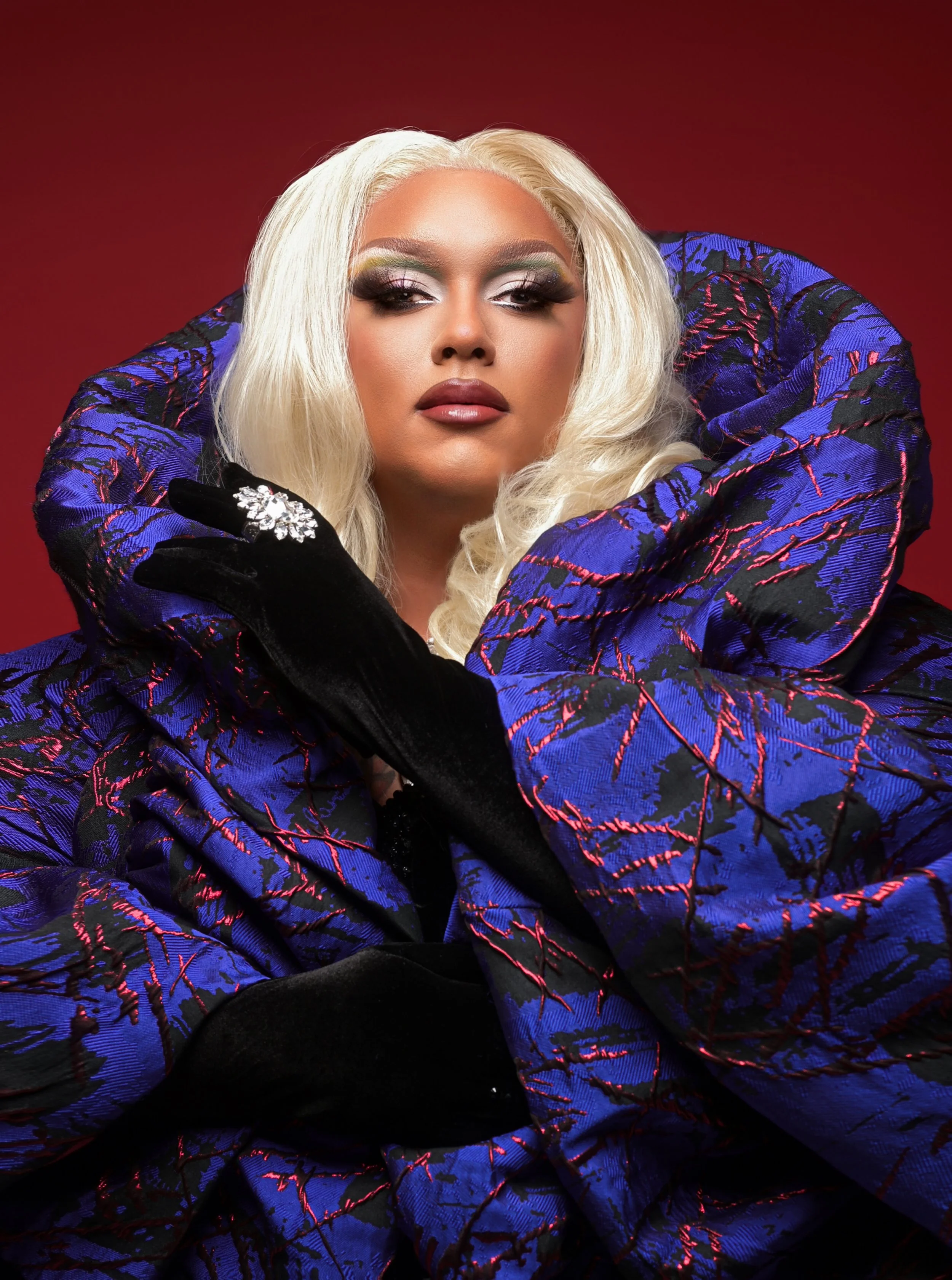
Drag artist and opera singer, Créatine Price. (Juan Jonas for Créatine Price)
Some artists spend a career asking for a seat at the table. Créatine Price built her own and set a place for all of us.
The operatic tenor and drag artist born Jordan Weatherston Pitts took her name from Leontyne Price, the soprano who broke the color line at the front of the house in American opera. Créatine carried it into rooms where the art form still hasn't fully opened. And, like Leontyne, Créatine made history in her own right: originated the first drag role written for a modern opera in Stonewall at New York City Opera. She made the finals of France's biggest primetime talent show as fully and unapologetically herself. And this week, on June 12th, she premieres her one-woman opera Project Créatine at ICA Boston, a semi-biographical work drawn from her years in New York nightlife.
Créatine chatted with POLISH about names as inheritance, the sopra arias opera purists clutching their pearls, surviving the comments section, and why she's finished shrinking for anyone.
POLISH with Marie-Adélina: The name Créatine Price is doing a lot of work. Leontyne Price broke barriers at the Met as a Black woman in a world not built for her, and you built a drag persona in her honor. What does it mean to carry that name into spaces opera still hasn't fully opened up?
Créatine Price: Carrying the flame of Leontyne Price, both in name and in spirit, is an honor and a privilege that I take very seriously. I hesitated quite a bit before renaming my drag persona — which did have to happen after a brush with scandal — so directly after such an idol. I didn't want to come across as disrespectful. She is the goddess. I realized early on, though, that every time someone asks where my name comes from, I have the opera-tunity to educate people who may not know who she is and let them discover her anew. That, too, is a privilege and an honor. It teaches people about the history of Black opera and familiarizes them with my brand of drag.
The name carries many meanings. Créatine also works beautifully on its own, even without the association, so I feel I've won in many ways — at least in my own head. I find that opera people who see what I do as disrespectful toward her usually have more of an issue with drag in general than with what I'm actually doing: honoring a legend. Something the last soprano I named myself after did not see.
You originated the first drag queen role written for a modern opera in Stonewall at New York City Opera — a historical marker most people don't even know exists yet. What was it like to step into that moment, and do you feel the weight of it now more than you did then?
Thank you for acknowledging such a pivotal moment in my career. Yes, Stonewall feels even more monumental to me now. At the time, I didn't fully realize the responsibility I carried. New York City Opera gave me the most important professional moment of my life, and I felt immense pressure to excel and represent my community well. It changed everything. I realized I was meant to blend these two art forms, and that I could develop myself as an artist entirely on my own terms. Walking into Stonewall felt natural and effortless. It exposed both my vocal strengths and my weaknesses, and it taught me that theater could truly be the thing I fell in love with all those years ago as a child. It gave me wings and — while I was still a baby queen — showed me what it felt like to be a star.
Ever since, I've strived to become a better, grander version of the Jordan who first stepped into that rehearsal room. I thank Iain Bell and Mark Campbell from the bottom of my heart, as well as my co-star Brian Myer, for encouraging me to audition.
You've talked about choosing soprano and mezzo arias for your drag numbers because they speak to you as a queen — even knowing that "people feel a certain way about that." What is it about those arias that fits Créatine, and what does it mean to laugh in the face of opera purists on your own terms?
I chose these arias because they embody the level of drama I aspire to as an artist. I often feel that women's arias in opera are far more dignified and glorious — more emotional, more complex. Tenors spend half their time singing about how beautiful women are and how powerless they feel before them. "Vissi d'arte," for example, is a prayer: lofty, spiritual, complete. These arias are the perfect foundation for drag, and they embody the strong femininity Créatine represents. I honestly no longer care what opera purists think. The truth is that singing Adriana Lecouvreur at every gig has made my tenor singing significantly better, and I genuinely recommend that more young tenors who want professional careers practice women's arias as part of their technique. Fuck the rules.
France's Got Talent is a mainstream, primetime stage, and drag is still a contested political act in a lot of those rooms. How did you navigate being fully Créatine on national French television, and what surprised you most about how audiences received her?
La France a un Incroyable Talent was a stressful but rewarding experience that exposed me to many positive and negative experiences. I felt at ease as Créatine largely because of Marianne James, whom I immediately felt understood by. Hélène Ségara equally embraced me for my talent and stage presence. But the public was divided. I knew almost immediately that I would not win, despite making it to the final. Two camps existed: the French television audience, who tend to see drag as either fun and campy or disgusting and vile — the latter usually much louder, much to my chagrin — and the opera algorithm, which really did not support me at the beginning. Many people saw me as a gimmick, an outlier, a fraud. That hurt deeply and made me feel even more rejected by an industry that had already spent much of my career rejecting me.
I chose to push back against those perceptions. I chose to show up and tell a story. Opera is — and always should be — for the people. I approach my drag from the perspective of music education, and I know that what I do will be a gateway for someone, somewhere, to become interested in attending performances at places like the Metropolitan Opera or the Opéra de Paris — hopefully helping keep this art form alive. I will always sing with integrity and keep showing up for the art that lives inside me.
You've described the aftermath of the show putting you in a dark place, with people resenting not just your singing but drag itself. How has that reshaped how you think about visibility, and what does intentional artistry look like for you now, on the other side of it?
I battled severe depression after the show. Hearing myself on less-than-optimal recording equipment and watching how emotionally invested I became during the semifinals and finals was incredibly draining. I also had almost no work for months afterward. Most of the opportunities that came the following year happened because I decided I would make them happen. I follow up. I go after what I want. It exhausts me. I read countless horrible comments online and didn't really reach out for help. Two people truly helped me through that period: my boyfriend, Ethan, who stayed by my side through all of it — especially the breakdown I experienced in January after the finale — and the acclaimed mezzo-soprano Anita Rachvelishvili, who talked me through many of those emotions and helped me gain perspective.
In many ways, I realized my voice wasn't fully ready. Spiritually, I communicated far more than I technically delivered. Some of my singing was crackly or flat, and my high notes often sounded strained. But I had never been on television before, so the learning curve was steep. It's harder than singing in an opera. I'm used to singing entirely without amplification, and the stakes felt higher than any performance I'd ever done. That experience taught me two things.
First, classical voices require very specific microphone setups — they often gave me an over-ear mic when I should have had a handheld, and I could have worked with a pianist, but that was never clearly communicated to me. Second, even if my personal best wasn't world-class every single time, I now understand exactly what I need to get there — and that I can ask for help, and ask for what I need.
You came up in New York nightlife — bartending, learning drag from the local scene — before opera handed you the Créatine opportunity. How did the underground shape who Créatine is in a way that conservatory training couldn't?
Bartending, go-go dancing, working in cafés, holding a corporate job, catering, and eventually finding drag — all of it shaped my go-getter attitude. One thing I noticed in nightlife was how often mediocrity gets rewarded simply because of the body someone inhabits, their skin color, or their social status. It's still that way. I looked around and thought, "I can do that, but better," and then I went for it. Créatine is the result of that spirit: the belief that I can do literally anything. I also struggled for a long time with being good at too many things, which sounds conceited, but genuinely, I can accomplish anything I set my mind to. Call me a Taurus: I will see it through. People don't always respond well to that, because they want you to fit neatly into a box. I say fuck the box. I grow. A growth mindset may sound very manosphere, but it truly is the way forward. The Zen mind is the beginner's mind. I learned that in nightlife. I learned discipline in conservatory — history, performance practice, musical form, things I take very seriously. Having artistic taste is, to me, a form of respect for art itself.
I also avoided becoming a drug addict, which unfortunately became the fate of too many of my fellow nightlife coworkers. I learned the dark side of New York City. I fell into abusive relationships — particularly one with a pianist — and that relationship became an integral part of my opera Project Créatine, which won the Creative Capital grant and debuts June 12th at the Institute of Contemporary Art Boston. Grief and loss aside, I would go back to those days in a heartbeat — to relive looking hot and being sad. Those experiences gave me my art.
As a Black queer artist operating in two worlds, classical opera and drag, which have both historically marginalized Blackness in different ways, where do you feel most free? And where do you still feel the weight of having to prove yourself?
This is something I think about constantly. I feel the door closing around conversations about intersectionality in both worlds — perhaps slightly less in drag — and it upsets me deeply.
Being a Black opera singer is one of the hardest career paths imaginable, because of the racism embedded in the history of the art form and the barriers to cultural inclusion that still exist. Yet participating in opera somehow lets you remain "acceptable," or adjacent to whiteness, so long as you conform to opera's existing standards. Many Black singers have been among my harshest critics for choosing to perform as Créatine — perhaps because we were always taught to assimilate and not make too much noise. We're taught to be grateful just to have a seat at the table. Meanwhile, I built my own table, and I invite all of us to sit at it. I invite our suffering, our joy, and our overachievement.
In drag, the Black queen community has been far more inclusive of someone like me. White queens, I think, can sometimes feel threatened by my ability to show up and perform at a very high level. Black people gag for Créatine, and I love us for that. I try to see what I do as an entry point into the arts. Arts education is profoundly important for our community, and I will carry that torch until I drop.
White people can be exhausted by these conversations. I honestly don't care anymore. Y'all already get everything.
What are your next moves? What's the version of this new phase you're building toward, and who are you building it for?
My next projects include the one-woman opera Project Créatine, inspired by real events from my life and my years in nightlife. The team behind it is incredible, and we're gaining significant visibility. We debut at the Institute of Contemporary Art Boston in June. Beyond that, I'm awaiting more television appearances and more chances to perform in operas and symphonic works around the world. I'm also developing collaborations with both French and New York–based singers. All of it is part of building the Créatine empire — and inspiring other brown queer kids like me to keep being weird and fully themselves. I want people like me to find joy, because I was robbed of it so young. I had to fight to reclaim it.
Finally, what inspiring words do you have for any up-and-coming drag chanteuse?
Sing the things people know first, then introduce them to the weird material. Sing it well, and for the love of all that is good, continue taking lessons and learn when to stop screaming over loud bar music. Be your own agent. Pay your taxes. Keep giving back to your audience and be generous. Work on your charisma. Practice how to hold a room and build a show. Be fierce, but also be respectful. Have a point of view.
