
The U.S. military kicked her out. Miss International Queen USA gets her now.
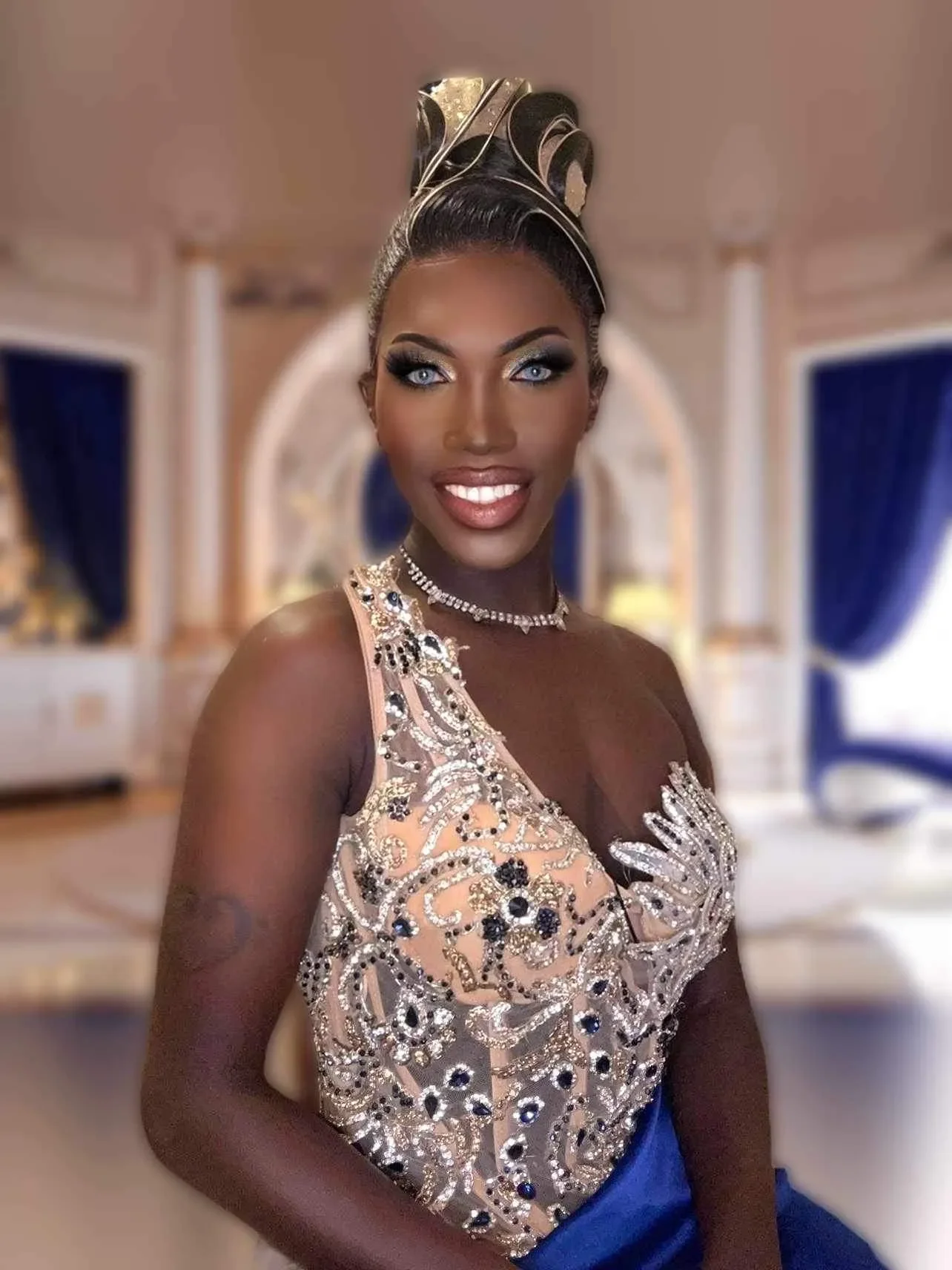
Altesse Aurum is set to compete in Miss International Queen USA later this month. (Courtesy Altesse Aurum)
Altesse Aurum didn’t come to pageantry to be palatable. She came to be seen fully, on her terms.
A former U.S. Air Force helicopter and cargo plane mechanic who served for 12 years in the military, including deployment to Afghanistan, she quietly transitioned while still in uniform. Altesse is now stepping onto the Miss International Queen USA stage as Miss Georgia. She may be one of over two dozen contestants, but she’s the only one who was forced out of the military under a transgender ban after years of devoted service.
Still, she shows up anyway, head high, crown incoming.
I had the pleasure of sitting down with Altesse ahead of Miss International Queen USA to talk about service, survival, and what it means to be the temperature gauge for a society still deciding whether to get it right.
Marie-Adélina de la Ferrière: Tell me a bit about yourself.
Altesse Aurum: I was born and raised in Daytona Beach, Florida. Well, really, from Bunnell, which is just a little one-stoplight town. Small town, little farm girl. I moved to Daytona full-time in third grade, graduated from high school there, and joined the military at 19 after one year of college.
At 18, I was very unsure of myself: 92 pounds, always upset with people calling me frail and feminine. I joined the military on a whim. Twelve years later, under a transgender ban, I was out. Ten of those years, I was a helicopter and cargo plane mechanic. I deployed to Afghanistan. I started transitioning in May 2023, almost three years ago now. I had my name changed and documentation updated by the end of August of that year. February 2024 is when I started presenting as myself at work while still in the military; the cutest little militant Barbie doll, as I like to say. They removed me out of uniform in May.
I went to work every day in civilian clothes until November. December 1st was my last day.
You’re stepping onto the Miss International Queen USA stage not only as Miss Georgia, but as a former U.S. Air Force service member and a proud trans woman. How have these parts of your life informed the way you carry yourself in this space?
It’s been difficult. Being a mechanic in a male-dominated space, I experienced that glass ceiling. Because I don’t walk around gloating about my skills, people assumed I didn’t know what I was doing. They’d discount me. Moving into pageantry, where there are a lot of heavy hitters –– former national title holders, new girls, a good blend –– I’ve developed a better sense of how I want to fortify myself and what I want my reign to look like. Everything I went through last year informed that.
One of my friends sent me a TikTok about the adaptations of a giraffe. Where does a giraffe go during a rainstorm on the savannah? Monkeys go up trees. Other things go underground. Giraffes are just too big; it’s seen as a weakness. But the narrator said something that stayed with me: sometimes you don’t need external protections because of internal design.
As a trans woman, I always wanted external protection. Laws to reflect me, people to respect me, and some degree of society’s validation. That phrase made me realize I’m already designed well internally. I don’t need those external parameters.
I started standing a little taller because of it.
You’ve described a journey shaped by service, perseverance, and self-determination. What did perseverance look like when no one was watching?
Perseverance looks like delighting in all your endeavors, no matter what. As a mechanic, it was taking the manuals home and reading. As a pageant contestant, it’s studying the history of the pageant, the history of the competitors. It’s being a student to the art you’re in. No artist steps into the art form and is immediately sickening. We’d all love to imagine we are. It takes study and practice.
When no one is looking, perseverance looks like reflecting introspectively, seeing how to bring out the best in you, and learning to shine your best attributes toward the light.
Georgia has a long lineage of pageant queens. But it also lacks strong protections for trans individuals. What does it mean to you to claim space in that legacy as a Southern Black trans woman right now?
I came to Georgia with the mindset of aiding the fight. People ask why I’m so passionate about Georgia when I just got here in December. And I say: if they allow it here, they’ll allow it anywhere. We have weak protections. The visibility of trans women here needs to be seen. We need to actively participate. There’s a deep sense that we don’t have a voice, and I want other trans women, trans individuals, and our allies to see that all it takes is one person. Hopefully, I have a lot of people behind me echoing the same sentiments.
Pageantry is often reduced to mere glamour. But it can be deeply political, especially for trans women. What does visibility mean to you in this particular cultural moment?
There is a deluge of everything right now. We just attacked Iran. Something happens every day with this administration. We’re all overstimulated. When everyone has something going on, it’s hard to give someone else’s issues visibility.
But pageants are a safe space for a glimpse–just a glimpse–into our communities. What brings people in is the attractiveness, the glamour. But what they learn through the stories of contestants is that there are 27 people on that stage with 27 different stories. Mine is: I’m trans, I got kicked out of the military, and how are the laws allowing that? Are other marginalized communities going to be affected, too? I like to think of myself as food for thought. You may not be trans, you may not be Black, you may not be a woman. But what they’re doing to me and my community, will they expand this to others? How far will it go?
Trans women have always been the temperature gauge for society. If we’re in a better spot, society is progressing. 2023 was a great year. Early 2024, before the election, we were reaching a place I’d call deep tolerance, even in conservative spaces. And now, under this administration, the legislation is moving against us.
What is the one thing giving you hope right now?
The democratic process. After the election, there was a lot of dread. But I’m seeing so many queer people, queer people of color, who are more actively engaged in politics in a way I’ve never seen before. People are media literate now. They look at information with a critical gaze. They can identify misinformation [and] disinformation. People on the left and the right are saying: I’m sick of this, I need to look at who will actually do the best for America, I need to look at character.
And if the wider part of society starts looking for character instead of polarized identities, I think they’ll start seeing trans people as individuals: as neighbors, as co-workers, as Americans. That’s what’s really giving me hope.
When you walk that stage in Atlantic City, what do you want the judges to see, and what do you want trans girls watching from home to feel?
For the judges, they should see the definition of perseverance and resilience. The confidence I’m exuding isn’t fake. It isn’t fabricated. It comes from a very deep place. I loved myself so much that I chose myself over a career I thought was going to be my everything. I was so dedicated to the military that I wanted to do 30 years. I wanted to dedicate my life to the advancement of democracy. But I chose me above all else. They’re going to see devotion to duty and a survivor who came through against all odds.
For the trans women at home, they should see someone the government tried to break. They tried to make me a victim. I’m not anyone’s victim. I took what happened, and I bounced back. They tried to stomp me out, and I just got back up...all the way back up to Miss International Queen.
